 Menu
Menu
‘Frost Land’ by Paul Marion
Frost Land
On the small balcony with purple morning glories and magenta zinnias in pots, I see two eagles flowing west to east, lower to higher, doing whatever they do at a time like this, but definitely showing themselves off in a faded blue flannel sky with a muted sun on a day with rain due. Layered into the distance are the various greens of woods and forest, barely Maine past rolling New Hampshire just off the coast, the greens softened by a damp atmosphere which also tamps down the sound of an occasional truck and the housing construction below on a main road.
With one eye on the eagles, I’m reading a 1946 compilation, 1965 21st printing, of the poems of Robert Frost introduced casually for the average reader by community organizer Louis Untermeyer, the tireless anthologizer of the 20th century, his Bob Frost coming to us in a brisk profile, highlights of the path to Famous Frost, like Famous Seamus of Ireland later:
born in San Francisco; rebel father’s early death there; mother-led return to New England roots territory, mill city Lawrence on the Merrimack River (echoes of cultural cousins Anne Bradstreet, J. G. Whittier, and H. D. Thoreau); in and out of college; part-time jobs teaching, doing factory shifts, and news writing; then a farm in Derry N.H. thanks to a grandparent; ten years of crops and poultry (with poetry on the side); ten years in the dirt before earning his way out of agriculture; selling the land to finance a last-ditch attempt to get noticed as an author by sailing to England with wife Elinor and four kids; walking into a London book publisher’s office and getting a deal to launch his first collection of poems, then another one, the second being “North of Boston,” which lifts him into literary orbit in his late 30s; followed by return to America and the late start of a career. World War I has begun. He steps off the ship and is the talk of the book world in New York City.
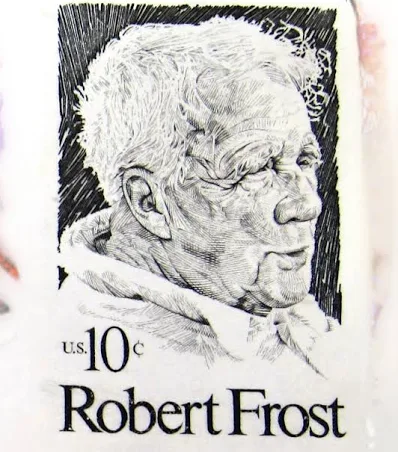
On his way forward he collects four Pulitzer Prizes for Poetry, teaches on numerous campuses, endures brutal family tragedies, makes a friend of a young President from New England, and achieves a commemorative U.S. postage stamp after passing in 1963.
Frost is still the codeword for “poet” in most of today’s America, more than Whitman or even Dickinson for mainstream recognition. “The Road Not Taken,” “Stopping By Woods…” “Nothing Gold Can Stay.” All this in the 75 cents paperback bought in a shop with “used books,” from a time when a regular person could get 200 pages of Frost’s poems for less than a dollar. Almost free. And still in circulation. In his own way he is all around us.
Paul Marion (c) 2026
Being from North of Boston, I love this piece and its sentiment, for Frost is with me, late and soon, midnight to noon…his voice gets in your head, whether out walking or abed…”You come too…’ A kind of pun in that love poem, you come to…’No tears in the writer, no tears in the reader,’ that’s good advice…’The only way out is through,’ got me through when lost in the swamp or some aftermath. ‘I will go farther–and we shall see.’ So, I keep following my nose, and so on, finding the stream where I can drink and be whole again beyond confusion. Nothing Gold Can Stay? Promises to Keep? Something there is that doesn’t love a wall, that wants it down? In hard times, I have often reached for Frost to lean on. He’s always there, even on an old man’s winter night. He’s never let me down. Thank you, Paul for the reminder here, for Frost is always good health to us.
Yes, a good reminder of a great local and international poet. In 1972, I was in Ireland with my father. We visited Hugh Toolan, my grandmother’s brother. I went into the town of Boyle with his son Tom, my father’s first cousin. He brought me to the library there, and went right to the poetry section, where he pulled out a book of the poetry of Robert Frost; I forget which edition. He showed me his name written several times on the card at the back of the book. “I love to read these poems,” he said. Ironically, when we first drove up to the farm, Tom was out “mending” a stone wall.
Jim, Steve—thanks for the comments on the Frost piece. We can’t remind ourselves enough of this giant in our midst. A book full of anecdotes, stories, and reflections such as yours would be a good addition to Frostiana. Maybe there is such a book and I haven’t come across it. “Readers on the Frost Road,” something like that.
Great précis and an urge for me to revisit both his personal and poetry, which does stay in one’s head forever.
Paul, I thoroughly enjoyed this awareness piece on Frost, from your opening paragraph, which set an envious, peaceful tone, to the succinct scorecard of the legendary poet, to how much you appreciated this 75-cent treasure.
I used to blame the English Literature teachers who taught us from elementary through high school for brainwashing us about RF and for assuming only those educated in New England could routinely recite or pay tribute to so many of his memorable lines.
But alas, even Google will attest that, above Whitman, Dickinson, and more recently Mayou, Frost is far and away the most quoted American Poet. I thank my early educators and you for reminding me how fortunate we were to trudge along the same snowy paths as a multi-Pulitzer Prize-winning poet.
And tonight, when I know I should be working on another book I promised my publisher but must first finish writing an article for Story Impact Magazine, and keep an eye on the Sox score, I’m reminded again that “I have miles to go before I sleep.”
The post itself is a poetic tribute to iits subject