 Menu
Menu
‘Sonic Boom’ by Paul Marion
Here’s a story, a memory from my early days in Dracut, Mass. When I was growing up, high-speed aircraft often broke the sound barrier even over residential areas. The enormous boom results from a massive shock wave caused by the aircraft moving faster than the speed of sound. This is something that has been regulated out of our daily lives for a common sense reason–think shattered windows and security alarms going off. But what I’m recalling is a rare accident involving a military plane. — PM
Sonic Boom: A Local Aircraft Story (1958)
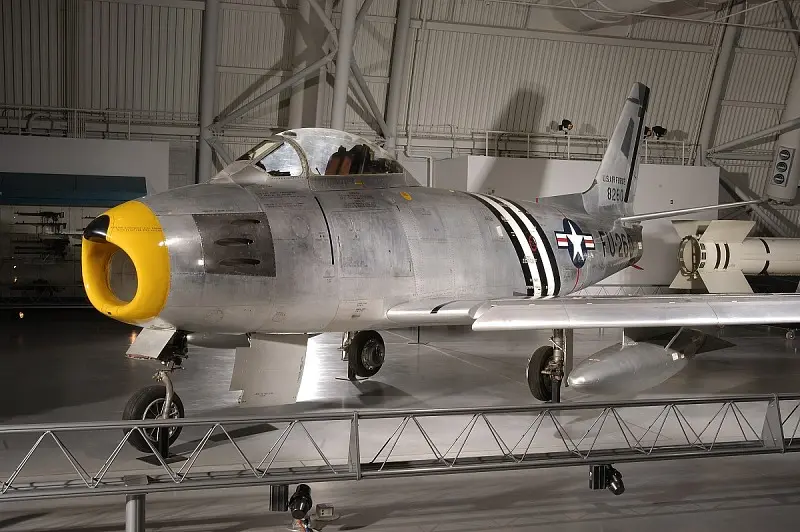
North American F-86A (P-86-A) Sabre jet, not the exact aircraft in the story (image courtesy of Smithsonian Institution)
The plane crashed. The pilot survived. I don’t know if I saw this or was told about it by my parents or remember the incident because I heard others describe it. In my mind I see myself in real time either standing in the front yard of my family home on outer Hildreth Street in Dracut with my father or with my mother looking out the west-facing picture window of our small ranch.
I was four years old on June 8, 1958, when an F86L jet fighter arrowed down out of the sky at 3:30 p.m. on a Sunday about a mile from my house. New Hampshire Air National Guard pilot Peter Gulick on a patrol flying out of Manchester, New Hampshire, was returning to Grenier Air Force Base when the engine on his swept-wing Sabre jet failed, “flamed out,” he said, forcing him to eject. A second jet on the same maneuver also went down due to mechanical issues and fuel trouble, this one in a forest many miles to the north. Both pilots were in the 133rd Fighter-Interceptor Squadron at Grenier.
Ray Kelly was outside in the Navy Yard section of town when he saw the plane descend at a frightening rate above the J. P. Stevens Mill next to one of the Beaver Brook dams, veering north to the New Hampshire state line. Archie Wolf and Ronnie Cartier were at Fox’s Dairy on Bridge Street a couple of miles to the east in Dracut Center. After the plane went out of view somewhere beyond the Rifle Range and Colburn Avenue, Archie’s father drove the boys to the scene. They waited on the road while the dad joined cops and firefighters who ran into the woods to help.
The sound in the sky. In those years we were not surprised by the sudden rolling thunder of a jet plane breaking the sound barrier. An aircraft reaching a speed faster than sound tripped a massive sonic boom, shaking the clouds.
But this was a different noise. The enormous bang of the “expulsion chute explosives” would have made my neighbors look up if they had not already spotted the transonic aircraft hurtling nose-first toward the forest at the end of Hildreth Street. The parachute carrying First Lieutenant Gulick sailed over and then into the distant dark green woods. The pilot did his best to direct the plane away from houses. He may have been 2,000 feet up with the jet going 200 miles per hour when he bailed out. His chute caught in a pine tree twenty feet up.
Chopping wood 100 yards away from the impact site, Alex Bursey dropped his axe and followed a trail toward the spot where he had seen the parachute touch treetops. He was able to help the slightly hurt pilot out of the woods. The jet smashed into a natural sand pit near a clearing with marshes and a small pond—more like a water hole—a place where my friends and I played hockey when I was older. Civil and military authorities, including Air Police from two nearby bases, sealed off the widespread crash site as best as possible. Jean Turner of the Lowell Sun reported that police turned away hundreds of sightseers in cars who converged on the crash location, eager to get a look at the shattered plane.
I learned much later that the Sabre jet carried “top secret” computer equipment designed for intercepting enemy aircraft. On summer days with fishing rods or just to snoop around, my friends and I hiked to the crash site and often returned with metal fragments as big as a hand. Twenty years after the crash, the largest parts of the jet were dug up and sold to a salvage yard for the still-valuable aircraft aluminum. Leo Gamache remembers because he drove the truck carrying the broken wings.
—Paul Marion (c) 2023
Interesting story. Good research on the details with the names of the people involved.
All of us boomers remember the sonic booms.