 Menu
Menu
‘Survey Team’ by Paul Marion
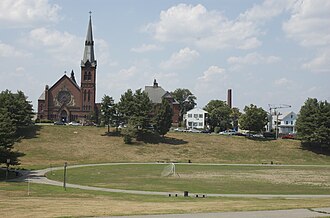
Eliot Church at South Common (Wikimedia photo)
Survey Team
With its spire ringed in scaffolding, the Eliot Church on the rim of the South Common in Lowell, Mass., looks like a church in Dresden, Germany, shown yesterday on the TV news, the spire there circled with staging from which workers guided a crane hoisting a new cross into place. Members of an Anglican church in Britain had commissioned a bronze cross in a goodwill gesture many years after the bombs. When I was young, my friend Mike Latour told me his father had been a prisoner-of-war underground with future author Kurt Vonnegut during the Dresden bombing by English and American fliers that burned large sections of the city in the winter of 1945. In Vonnegut’s novel Slaughterhouse-Five, he tells the story in off-beat form. With our gang of kids Mike had worn his dad’s green combat belt with a soldier canteen when we played army in our woodsy suburb just north of Lowell. I had my father’s tailored Eisenhower waist-jacket that hung loose at my shoulders. In his bedroom bureau, middle drawer, were souvenirs of World War II, including an edition of the Stars and Stripes military paper headlined: HITLER DEAD.
Ahead of me on the track on the floor of the Common this morning are Mr. Nguyen and Mr. Hong, both wearing faded camouflage baseball caps, which makes me wonder if they are veterans of the Army of the Republic of Vietnam (ARVN), South Vietnam, who have lately gathered with local American Vietnam War vets for Memorial Day ceremonies. Chanlina, a nursing assistant at the community health center, is a quarter-lap behind me, and gaining. When I passed her earlier, I read the back of her T-shirt, Survey Team, left over from the recent census. Everyone walks in the same direction, against the clock, face into the low sun until the turn at the pool. Now and then, someone crossed the soccer-lined infield diagonally, rushing to the train station just beyond the western edge of the park.
When I arrived at 6 a.m., Mr. Ya was stretching with four neighbors from South Street, friends who likely would have been strangers had he passed them in a park in Saigon, now Ho Chi Minh City, where he was a newspaper editor during the war. He wears a brown fedora out of a Humphrey Bogart movie, tweed sport coat, gray pants, white shirt open at the collar, and blue canvas shoes. Before he starts walking around the asphalt oval, he pulls out of his coat pocket eight small stones, which he arranges in two rows of four on a bench near one of the oil-drum trash barrels. After each turn around the track, he stops to return one stone to his coat pocket.
He doesn’t keep up with his companions and sometimes waits until they catch up to him so he can chat again. With his cane, he can match their pace for more than an eighth of a mile. When I pass his group on the inside lane, saying “Hello,” Mr. Ya and friends nod, smile, and wish me a good morning before getting back to their own words. The peppy conversation reminds me of my grandparents and parents chewing over the day’s events in French. He probably knows French from the old country. Mr. Ya is about eighty and arrived in 1977 at the beginning of the resettlement period for thousands of refugees from Laos, Cambodia, and Vietnam. The Eliot Church atop the rise kept an open door for people arriving from the camps in Thailand and the Philippines. The sign out front today announces services in Swahili for the Kenyan community and also in Portuguese for Brazilian immigrants.
In the front hall of my family’s house across the street from the park, there’s a long panorama photograph. On April 19, 1919, George H. Russell, owner of the local Commercial Photo Shop, captured in his trendy format hundreds of people on the South Common, all along the north slope of Meetinghouse Hill, topped by the red-brick Eliot Church. It was Patriots’ Day, a state holiday since 1894. The church and houses on Summer Street made it into the picture. In reverse on a dark tree limb, Russell inscribed: Lowell’s Welcome to her 26D Boys.
Back from the trenches of Europe after defeating the Germans with allied help, the soldiers assembled. In the frame are nurses and nuns in white uniforms and habits, Knights of Columbus in regalia, French flags, kids in doughboy outfits, black-suited city leaders in bowler hats, women in Sunday coats, and officers wearing General Pershing cowboy-type campaign hats.
We run and rerun private History Channel tapes in our brains. I’m stepping through the afterimage of one George Russell composition this morning, just a moment in a parade of negatives. CNN’s Early Report from Afghanistan this morning told us about a soldier who shot a twelve-year-old boy who had run to be with his father after the soldier spotted the boy and ordered him to stand still. The soldier saw the boy as a threat. It took two hours for a helicopter to arrive and transport the kid to a field hospital, where an army doctor told reporters that he is recovering. The father said his wife returned to the rocky hillside where her firstborn son was wounded to beat the ground and wail.
Paul Marion (c) 2004, 2026