 Menu
Menu
Prayers, Pies and Prizes
Prayers, Pies and Prizes
By Leo Racicot
I’d be lying if I said our mother looked forward, as did so many of the parents of our Saint Patrick’s School classmates, when the school year rolled around to school community-related activities such as raffles, school fairs, bake sales, paper drives. As a widow, and as someone who was innately shy, she felt not entirely comfortable among the other parents, most especially the mothers of students who had early before I entered the flock in second grade (I spent my first grade year at The Morrill School across the street) formed impenetrable cliques. I don’t think my mother was paranoid about not fitting in; even as a child, I observed a certain, if not snobbery or disdain, a palpable reserve towards her from other mothers. There was, indeed, a stigma attached to a young widow, a widow’s children. I never talked with Diane about how she felt but I, myself, experienced the curiosity, if not the downright scorn, of classmates as being one of the only two kids in the whole school whose father had died. (The other was Karen Waite whose father or mother (I forget which) had died, leaving her half-orphaned. Whispers about the two of us were heard, no matter how hushed, whispers and insults. I remember being so incensed by remarks aimed at me by a group of students one day at recess in the school yard that I found myself countering with, My mother’s been married seven times so I have seven fathers! No one seemed to challenge this and one kid, Danny Mullen, looked at me in an awe usually reserved for astronauts. So, there was this to be lived with — being fatherless for us, Diane and me — being husband-less for our mother.
School group gatherings were awkward for her, I could plainly tell second only to root canals on her list of “things to be avoided”. As I started out saying, she cringed whenever an invitation from the nuns was sent home with us requesting her participation in this or that fundraising event: a solicitation for a cake for a bake sale, say, or an appeal to volunteer her time for a paper or penny drive. Appeals to craft homemade aprons and potholders for school hall raffles made her an absolute wreck. She’d protest, What are you kids getting me into now?? One “ask” we all three of us wanted to run from was the two or three times a year the nuns asked families to sell chances, raffle tickets for a fair, or Holy Childhood Seals drives, whatever the parish deemed necessary to fatten its coffers. Good sport that she was, my mother sometimes bit the bullet (you couldn’t bite the bullet every time the nuns asked or you wouldn’t have any teeth left in your head) but she was game to once-in-a-while try to lend a helping hand to her two very put-upon children. I’d inherited my mother’s shyness, either that, or it had imprinted itself upon me, so I wasn’t too eager to go knocking on neighbors’ doors for what seemed to me like panhandling. Classmates from nearby streets were knocking on the same doors. It wasn’t uncommon for me, when I’d find the courage to approach neighbors, to be told they’d “already given”.
In spite of all this donation trepidation, lame sales pitches, I did like the end results of the fundraisers. All anxiety melted away once we entered the school halls, the church basements, greeted by the festive cakes, the brilliantly decorated tables, the colorfully-draped ceilings, food and drink goodies so abundant, a child’s eyes, hands and appetites didn’t know where to begin. Usually the centerpiece of these events was The Money Doll. “Money dolls” were an arts and crafts fundraising staple where a doll (often dressed like a bride or a First Communicant girl) had paper currency — usually ones, fives, and tens — folded, fanned, pinned, origami-style all over its dress or attached as a cascading skirt. These were quite the popular money-maker themselves; everyone bought a ticket hoping to win the jackpot. There could be only one winner though but everyone left with something before going home, if only a full stomach, a satisfied sweet tooth. The frenzied scramble to become overnight salespeople was left far behind. Until the next time…
____________________
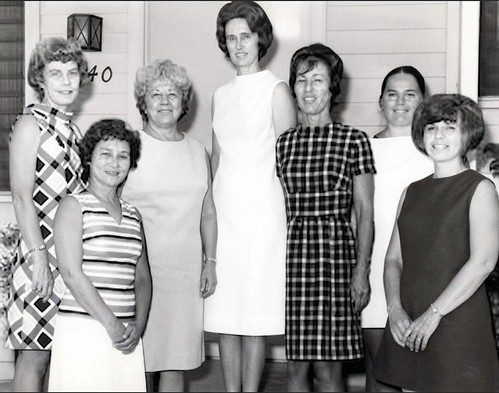
PTA mothers in 1960s
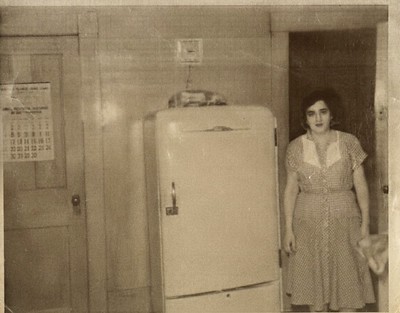
Our mother in the 1960s

A money doll

Holy Childhood Seals

Bake Sale table