 Menu
Menu
‘The Map–Early Days in Dracut’ by Paul Marion
While I was born in Lowell, I grew up next door in the town of Dracut, the only place in America with that name, derived from a Draycot in England. Keeping the “y” in the name would have ensured that people know how to pronounce it. This woodsy land was Native American territory for thousands of years before the European settlers came in the 1640s and then made the place an official town in 1701. My family and thousands more were suburban pioneers in the 1950s. We had the advantage of commercial Lowell being close by for shopping and medical services, but the semi-rural setting was far different than what my parents and ancestors had known since landing in the textile factory city in 1880. I’ve been writing memory pieces about the early years in Dracut and am sharing the following one which gives a sense of what it was like in town when I was young.–PM
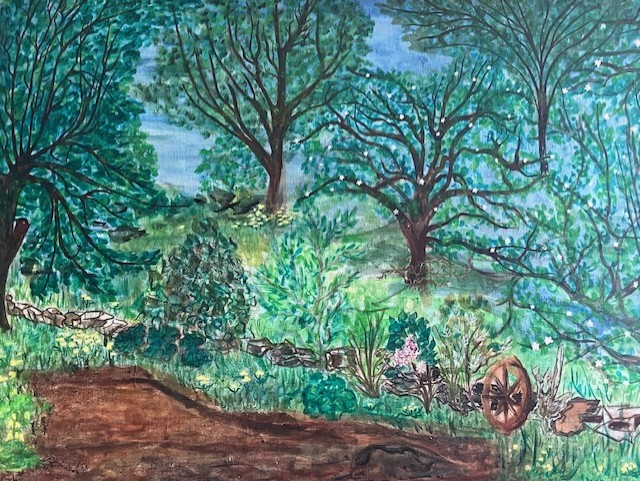
“Hildreth Street Garden & Trees” by Richard Marion, (oil on canvas, c. 1962)
The Map
Three old apple trees stood in the Hildreth Street yard. For the sixteen years I lived there, we never picked good fruit. Of course, we didn’t spray or prune the trees. Two trees in the side yard bore a Red Delicious apple; the other tree was a McIntosh. We could pull a few good Macs from the tree in the back if they were picked early. I’d sit in the largest V of limbs and get three bites out of scrawny sour green apples. The Delicious trees gave wormy, blemished fruit. Each fall we raked the drops so that lawnmower blades would not get gummed up with sliced apples. My father tired of picking up the apples and one year dumped them into the back of his vegetable garden, covering them with grass clippings. The rotten apples gave the soil an acid overdose, forcing him to plant tomatoes at the opposite end of the garden the next year. His tomatoes were prizes on stout plants with stalks enriched by sheep manure that he brought home in bags from the wool processing mill in North Chelmsford.
I asked my brother Richard, who is ten years older than me, about moving to the Hildreth Street house from Orleans Street in Lowell’s Centralville neighborhood, and he wrote:
Sandy edges of the inclined driveway, paved in blacktop, accommodated two-foot-high purple- and magenta-blossom zinnias while my castor beans planted as a yard-edge barrier struggled, versus the roadside-grazing finds I’d transplanted at the fieldstone property line in a low-lying zone of vigorous day lilies, which were highly irrigated from the topsoil-depleted sold-acres next door where stood the abandoned elevated turkey pens. The loss of drinking orchard trees and willows due to the land-clearing added to water problems in many of the new ranch cellars. The inexperienced builders had made errors in foundation-siting and grade levels.
Along the southeast side of the foundation large white hollyhocks seeded themselves and flourished in enormous sunlight. The original ribbed, red-wine wooden shakes were later painted green, matching the broad leaves of the hollyhocks. Around the front cement stair-block, five steps, grew intense red zinnias in a crescent garden, a gift from Mrs. Fournier across the street. The sturdy flowers may have benefited from years of nitrate-rich manure from her animals. On the borders of Dad’s modest vegetable garden, cosmos, marigolds, and petunias thrived in season. The right rear section had the tall ‘dinner plate’ dahlias and staked, sun-drenched beefsteak tomatoes. Some years, zucchini and cucumber tendrils ran between the tomato plants.
An explorer amidst seemingly untamed overgrowth in surrounding fields and woods, I gathered pieces of tree limbs and roots, unaware of wabi-sabi or bonsai ideas, and arranged them toward the back of the garden. I had seen Mémère Roy’s coffee-table artificial Asian plant, an Easter gift from her sons. In late fall, I harvested fir, laurel, and pine boughs in the woods for Christmas wreaths that I made in the cellar and sold to friends and relatives. The spending money came in handy at the holiday.
He offered an equally detailed survey of the house interior, from closet dimensions and refinished cedar chest to his college-time drafting board positioned at his middle-bedroom window with a view toward the weightless white apple blossoms edged in pink each spring. At one point he rescued a black-leather reclining couch put out for trash down the street and replaced his standard bed. It looked like a psychiatrist’s office in there.
The immediate neighborhood consisted of young families and my grandparents, the old folks of the street. Most of houses were modest in size and built on lots squared out of farmland that was ringed by woods. For my parents, the low-interest mortgage was their war chit from my father’s veteran’s benefits, the so-called G.I. Bill—a ticket out of the declining city. They paid $14,000 for the compact, three-bedroom ranch house in 1956. I found an undated receipt for a five percent down payment written in blue ink on a lined page torn from a pocket-sized, spiral-bound notebook:
Mr. Marion,
Received from Mr. Marion
$700.00 deposit on House situated
on 1249 Hildreth St.
Costas G. Psoinas
That’s not the name of a real estate agent. That’s the name of the house builder, the developer in today’s language, but back then the term was “contractor.” I’m pretty sure it was his first house sale or one of his first sales. He built many houses in the neighborhood, an area sometimes referred to as Crosby Heights for Crosby Road. Hildreth Street was the main street at the bottom of the hill. The new Janice Ave. and the venerable Crosby Road ran up the hill on either side. Three new streets linked those two: Christy, Stephen, and Gloria. Another uphill street was started but abandoned. The names are from the contractor’s family—his wife, Janice, and kids. Hildreth and Crosby are named for ancient Dracut families. Later, two small housing tracts were added to the neighborhood: Raven Acres and Cinderella Circle. Other builders developed these. Raven Acres has three streets: Raven Road, Oriole Drive, and Blue Jay Avenue. Cinderella Circle was carved out behind our house in what I knew as Gendreau’s field. Fifteen houses sprang up. I didn’t like the precious Cinderella name.
So many ethnic families from Lowell were moving into Dracut and other towns ringing the city that the Sun newspaper introduced Suburban News. Almost everyone had relatives in Lowell, shopped downtown, used dentists and doctors with offices on Merrimack Street, went to movies at the B. F. Keith and Strand theaters. Dracut offered none of these, but its Lakeview Park and Ballroom had long been popular with Lowell people. The amusement center on Lake Mascuppic, good for swimming and boating, had a dance hall, carousel, and arcade with a floating duck game. Pull a duck from circulating “pond water” at the counter and check to see if the number on the underside matches a prize like a plastic comb or a stuffed bear. Lakeview Park on the edge of town near Tyngsboro had been brought into easy reach by the street trolley company decades earlier. Later, an IGA supermarket opened near the high school and a dentist moved into the Navy Yard business cluster at Lakeview and Pleasant streets.
Here’s the layout:
C G L O R I A J
R S T E P H E N A
O C H R I S T Y N
S I
B C
Y E
D E R
N E
I L
C L
A
X <<<Marion house
<<< H I L D R E T H>>>
This diagram is not to scale, but it shows the relationships of streets. While growing up, I didn’t know anyone versed in town history. That changed when I was a junior in high school and had a teacher who stressed the importance of local history—her name was Mrs. Norton. My parents were really Lowell people. Many third- and fourth-generation Franco Americans, Greek Americans, Irish Americans, and Polish Americans moved from Lowell to Dracut after World War II. These new suburban dwellers were more wrapped up in their ethnic backgrounds or the city’s history than in the town’s heritage.
Paul Marion (c) 2026
“Later, an IGA supermarket opened near the high school and a dentist moved into the Navy Yard business cluster at Lakeview and Pleasant streets”
My mother’s maiden name was Sintros, and her father’s relatives owned and operated for 37 years the ‘Sintros Market’ on Lakeview Avenue, in the Collinsville section of Dracut where the CVS now is. It closed in 1984.