 Menu
Menu
Why Do I Tell the Franco-American Story? by Paul Marion
With the annual Lowell area Franco-American week celebration coming up later this month, this seemed to be a good time to re-run this brief essay. There are two million descendants of French-Canadian immigrants in New England. In 2020, I was asked by the hosts of the French-Canadian Legacy Podcast in Concord, New Hampshire, to answer the question below. I wrote the following for the podcast blog.
Why Do I Tell the Franco-American Story?
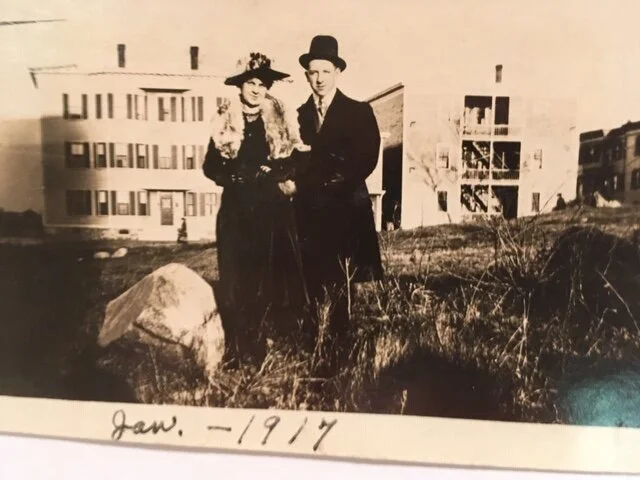
My grandparents, Antoinette and Wilfrid Marion, in Little Canada, Lowell, 1917
.
I believe it is important to know your roots. I believe that you have a better chance to know who you are if you know where you come from, if you know how you got to where you are today. Why is it important to know who you are? I believe you will lead a more fulfilling life if you have a sense of how you fit in the larger flow of humanity. It’s about what I call coherence, which I take to mean having a unified sense of being, a feeling of being whole in body and soul and mind. It’s the opposite of being alienated, the feeling of being disconnected from society. Knowing who you are and where you are gives a person a better chance of feeling a sense of community, a sense of belonging to something larger than your individual self.
The question “Who am I?” has the simplicity of the old Baltimore Catechism question, Who made me? In Catholic grade school a lot of answers were provided. Just memorize what’s in the book. Just listen to the priest at Mass. Just do what Sister Thérèse de l’Enfant-Jesus says. The authorities offered a lot of answers after providing the questions as well. But in all those school days in a French Catholic elementary school, I don’t recall any of the authorities telling us how the French Canadians wound up in Lowell or Dracut, Mass. There was no local history in school. They customs, yes, like singing the Canadian national anthem in French and displaying the Quebec province flag in the classroom next to the red, white, and blue U.S. flag. Sometimes the Mass was said in French. Early on it was in Latin in my day. Then it was English with the priest facing the faithful in the pews. “Pray, pay, and obey,” was the unspoken game plan.
We had a few “French” items in the school cafeteria like Chinese Pie or Pâté Chinois, the regional concoction that is a twist on Shepherd’s Pie or Cottage Pie from Ireland and Britain. Until the canonical law changed, we were not served any meat on Fridays. Gooey mac and cheese, tomato-rice soup, crispy fish sticks were popular. Some kids didn’t go for the hot lunch. We had French language day on Thursdays and French courses, grammar and conversation, all the time. At home my parents spoke French to my grandparents and their siblings (not all the time). We visited relatives on New Year’s Day, which is special for the French Canadian-Americans. The older generations told stories about the immigrants and subsequent generations. My ancestors on both sides came to Lowell, Mass., in 1880. Despite all this, my generation turned out to be highly American in identity.
As someone interested in history, I always had a sense of my past and was curious but not in any extraordinary way. I lost my ability to speak French fluently, even semi-fluently, after high school despite four years of French reading comprehension and conversation classes. One of my brothers attended a French Catholic high school, but I chose not to. As the years went on, I began to think more about my family’s origins. When my son was born in 1995, the sixth generation of our line in Lowell, he came to my wife Rosemary and me with her 100 percent Irish roots stretching back to 1870 in the city and my 100 percent French background. I realized that he would be far from his ethnic origins. It would be up to me to give him some grounding so that he would have an understanding of where he comes from. With any ethnic link, a special challenge is keeping in touch with the roots when a person no longer has the native language, whether French, Portuguese, Khmer, Spanish, whatever it may be. Our son’s arrival heightened my commitment to tell the French Canadian-American story in my writing, both the Lowell area French story and my family’s place in it. I’m still reconstructing the family experience. Fortunately, two of my aunts had researched the genealogy of the Marion and Roy lines as far back as the mid-1600s in Normandy, France. The paper trail doesn’t go back farther, so far. I’ll keep at it.
And so, as a writer, I have a way to tell the story of my family, my community, my people. The knowledge has added texture to my experience. Embracing the identity has opened up connections to other people in New England, in Quebec, around the U.S., and abroad. I’m part of a larger effort to remember. At the UMass Lowell Center for Lowell History, there’s a transcript of an interview with a French Canadian-American woman from Lowell from the 1980s. In it, she tells stories about the Lowell French in her time, early 20th century, and she sings songs. The lyrics are reproduced. Speaking to the interviewer, she says at one point, “I’m a memory worker.” That captures what’s going on in this telling of the French-Canadian story in America. Those of us who write, speak, sing, research, and more are all memory workers in the big Memory Bank.
— Paul Marion (c) 2020
Merci beaucoup, Paul, for the memory work!
I am very interested in Acadian history and their emergration
Born & grown in Maine into a family speaking French(via Quebec ancestors), Danish(via New Brunswick), at a time when Quebecois 17th Century- French was banned by Maine State law in the schoolyard while so-called pure, Parisian French ruled in the classroom, such were those days…Thanks, Paul, for reminding us all to keep this story alive.
A lovely post and testimonial, Paul. Just reading the names of the foodstuffs triggered my tastebuds–I immediately remembered my Mémère’s rice soup (flavored with a big ol’ hambone), New England boiled dinners (with a generous splash of vinegar), and her sublime zucchini bread.
A newly-picked tomato from the garden with nothing but fresh-ground pepper was about as good a snack as one could find on a warm summer’s day.
Memory work, indeed!
Cheers!
So many Franco-American memories need to be shared, written down, cataloged, kept for posterity and thus remain alive forever. ALL of them really! Thanks Paul for contributing to this sacred mission.